Squeeze bottles for a griddle: choosing ones that do not clog

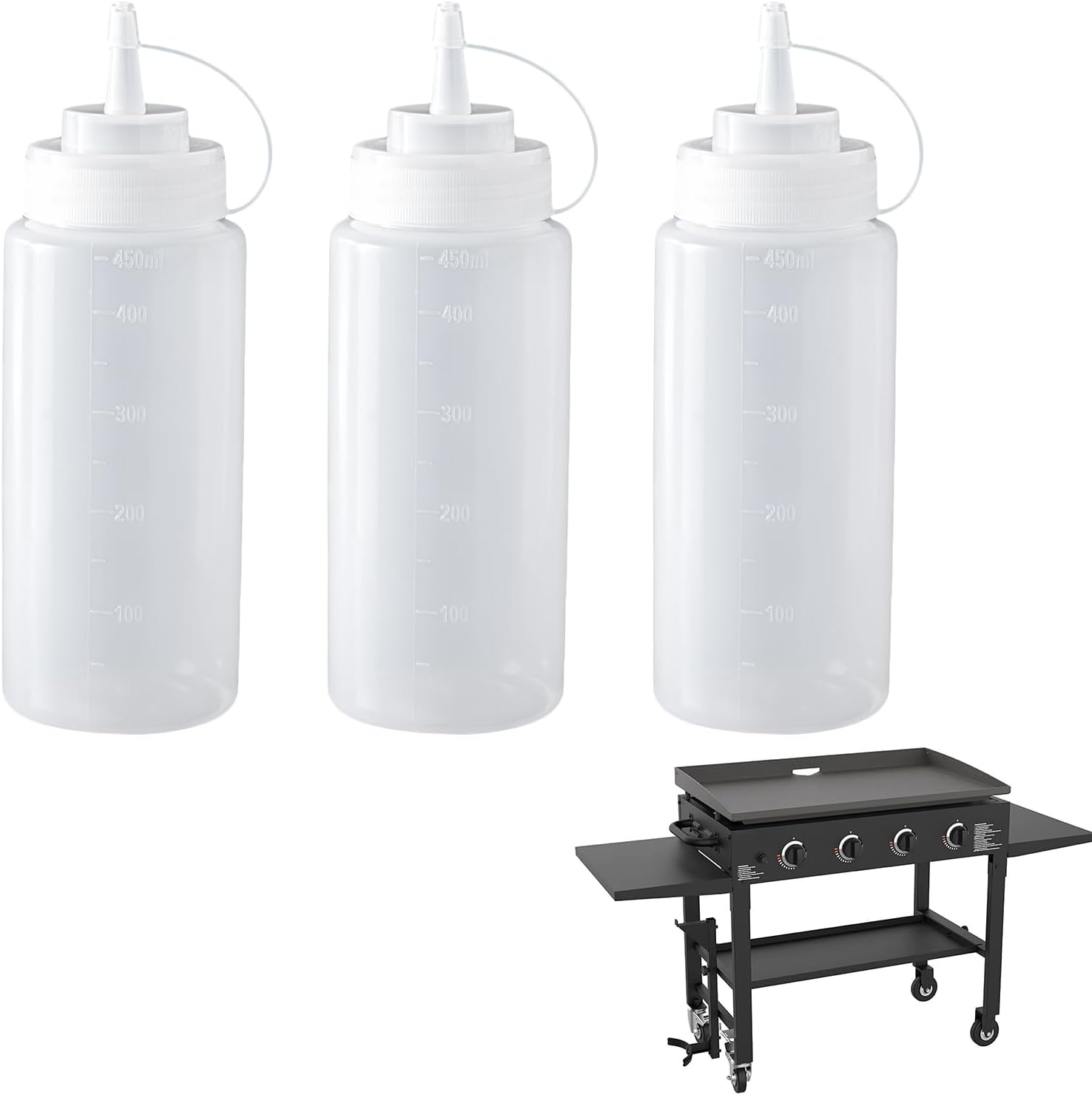
Squeeze bottles look like the simplest possible product, and they are, right up until one clogs mid-cook or drips oil across a hot surface. Both problems come down to the tip and to what happens to the contents between uses, which makes them straightforward to avoid.
Match the tip aperture to what is going in it
A fine tip gives precise control and clogs immediately with anything containing particles. A wide tip pours freely and is useless for a controlled drizzle.
Thin oils suit a narrow tip; sauces with any texture need a wide one. Sets with interchangeable tips solve this properly rather than compromising on one size.
Oil residue is what actually causes clogs
Oil left in a tip oxidises into a sticky varnish over days. That, rather than food particles, is what blocks most squeeze bottles used for oil.
It builds up slowly, which is why a bottle works fine for weeks and then suddenly does not.
Cap them between uses
The caps are not decorative. An uncapped tip lets air at the oil constantly, which accelerates the process above and lets dust settle directly into the aperture.
Capping after each use is the single habit that most extends the life of a squeeze bottle.
Clean while it is warm
Warm oil rinses out easily; cold oil does not. Cleaning at the end of a cooking session, while everything is still warm, is markedly easier than doing it the next day.
Hot water and a little detergent through the tip, then a rinse, is enough at that stage.
Keep them away from the heat itself
Most squeeze bottles are LDPE, which is fine for contents and not fine against a hot griddle edge. A bottle resting on a hot surface will deform.
A dedicated spot away from the cooking surface avoids it. This is the most common way griddle bottles are ruined.
Label them if you use more than one
Oil, sauce and water bottles look identical once filled, and applying the wrong one to a hot surface is at best a wasted piece of food.
Coloured caps or a written label solves it. With three or more bottles in use it stops being optional.
Bottles on our shelf
The squeeze bottle sets here come as multiples, which is what you want when oil, sauce and water each need their own. On our own shelf that range currently runs from $9.99 for the Fevbcnrj 16oz Squeeze Bottles for Blackstone Griddle – 3 Pack, Leak-Proof up to $9.99 for the Fevbcnrj 16oz Squeeze Bottles for Blackstone Griddle – 3 Pack, Leak-Proof.
Each of these sits in Condiment Bottles; there are 1 product in that group today. The figures below are the charged prices, and nothing further is added at payment.
Related reading
Two other pieces on this site cover ground next to this one. Cap fit is a measurement, not a brand match, and the measurement takes ten seconds. And on a related note, a boot solves noise and dents, and introduces one problem of its own if you never take it off.
- Measuring a water jug neck so the replacement cap actually fits
- Silicone bottle boots: what they protect and when they cause problems
Clearing a blocked tip
Warm water is the first move, because the blockage is usually oxidised oil that softens with heat. Soaking the tip alone in hot water for a few minutes clears most cases without any tools.
A cocktail stick or a pin clears what remains, working from the outside in. What is worth avoiding is enlarging the aperture with anything metal and rigid, because a tip reamed out to clear a blockage never gives a controlled flow again.
Filling and storing them properly
Filling to the very top leaves no air to compress, so the bottle either will not squeeze or delivers an uncontrolled surge when it does. Leaving a couple of centimetres of headroom gives proper control.
Storing them upright rather than on their side keeps the contents away from the tip between uses, which is where the varnish forms. Combined with capping, that is most of what keeps a squeeze bottle working.
Choosing between LDPE and silicone bodies
Most squeeze bottles are low-density polyethylene, which is soft enough to squeeze easily and cheap enough to replace when it eventually clouds. It is the standard for good reason and it suits nearly every use.
Silicone bodies cost more, tolerate more heat and stay flexible longer, which matters if a bottle lives near a hot surface. For a griddle setup where bottles inevitably end up somewhere warm, that extra tolerance is worth paying for.
Keeping them working
Choose the tip for the contents, cap them between uses, clean them warm rather than cold, keep them off the hot surface, and label them if there is more than one. Bottles treated that way last for years and never clog at the wrong moment.
Parts go out from Los Angeles, CA at a flat $3.95, free past $29. Unused returns are accepted for 30 days. Write to [email protected].